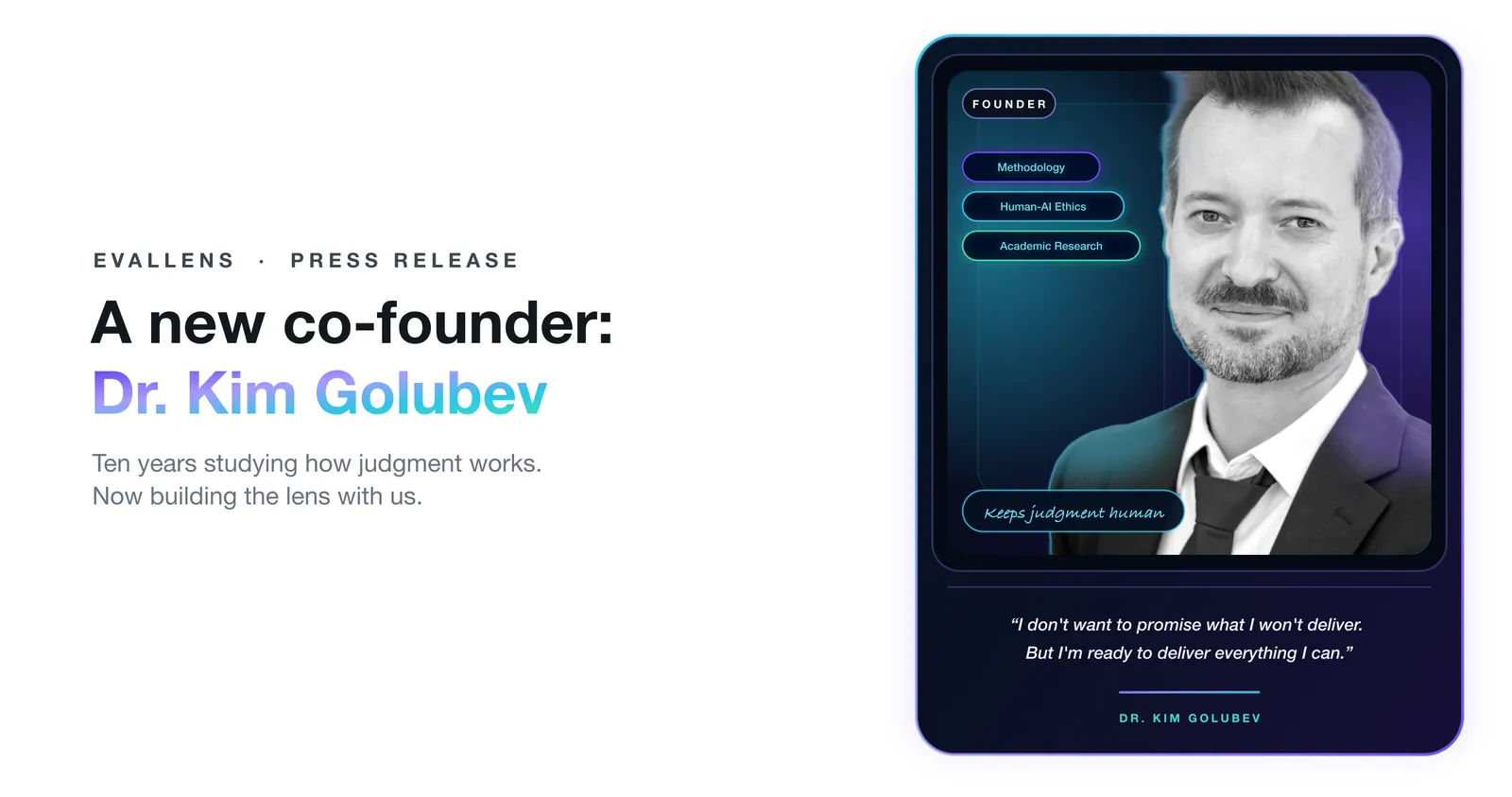
On weekday mornings, Dr. Kim Golubev teaches English at a school in Silicon Valley. Evenings and remote hours belong to the University of Nevada, Las Vegas, where he earned his Ph.D. and picked up an Outstanding Teaching Award on the way out. As of this week, the hours in between belong to us.
Kim is joining EvalLens as a co-founder.
Who is Dr. Kim Golubev?
Dr. Kim Golubev is a professor at the University of Nevada, Las Vegas who also teaches English at a Silicon Valley school, working where literary theory, posthuman studies, and AI meet. He defended his Ph.D. dissertation, Posthuman Vital Materialism, at UNLV in 2025 — an inquiry into what happens to agency, identity, and responsibility when humans stop being the only actors in the room. At EvalLens he'll lead research and academic partnerships.
The short version of the CV, because it's a good one:
- Ph.D. in English Literature, UNLV, 2025. The dissertation builds a theory of distributed agency and decentralized ethics — how meaning and responsibility work in systems where humans and non-humans act together. In his own words: "The vital posthuman theory does not challenge the freedom, but the notion that there was an a priori self-will distinct from other-will."
- The first Crimean Tatar to earn a Ph.D. in the United States. Not a line on a CV — a first that belongs to an entire people, and he's the one who carried it across.
- UNLV Outstanding Teaching Award, 2025. He teaches mythology, British and world literature, and composition.
- A book on the way. Posthuman Vital Materialism is forthcoming from Palgrave Macmillan, a major international academic publisher — worldwide distribution, translation rights included. (The contract terms are the one thing he's not allowed to talk about.)
- A working podcast habit. He hosts the Post-Podcast on the UNLV English channel — long-form conversations with scholars about war, media, poetry, and apocalypse. Light listening.
He's on LinkedIn, where all three of his current jobs involve teaching someone something. We intend to be the fourth.
Why an evaluation company hires a literature professor
One of the four principles on our About page reads: methodology matters more than the model. We mean it literally. A scoring system is a theory of judgment with a UI. Rubrics, criteria, structured disagreement, the difference between an opinion and an evidence-backed reading — none of that was invented by AI labs. The humanities have been arguing about how to evaluate work fairly, and what an evaluator owes the work in front of them, for a few centuries longer than machine learning has existed.
Kim has spent a decade inside that argument. His research asks what happens to agency and responsibility when action is distributed across systems, human and otherwise. We ask a smaller version of the same question every day: when AI prepares the analysis and a person makes the call, who owns the decision?
What we gain in Kim is someone who can take that answer apart, put it back together, and tell us where it will bend. When we first walked him through the product, he gave us the line we'd happily put on a wall: "This is the theory becoming application — the thing I wanted to build myself, but had no idea where to even begin."

Why now
Kim didn't join a startup that happened to have an open seat. He joined because of what EvalLens is today — and what it's about to become.
Today, EvalLens does one job and does it with receipts: batch evaluation of pitch decks for competitions, accelerators, and VC deal flow. Six specialized lenses read every deck, every score is tied to evidence from the slides, and the organizer makes the final call — a defensible ranking in minutes instead of weeks. That's not a stepping stone we're apologizing for. It's a working product with live events, a fund pilot, and partnerships behind it.
Next is the part we've been quietly building toward. AI agents are starting to do work that used to take teams, and someone still signs for the result. Execution is becoming abundant. Responsibility stays scarce. And scarce things acquire a price. Internally we call it the price of responsibility: once work is delegated to machines, evaluating that work — and proving who stands behind it — becomes the scarce skill. Everything EvalLens does today is the first stage of that larger arc.
We'll unveil the full vision next week, in this Newsroom. It's the reason a scholar of distributed agency said yes to a startup. Asked what he could commit to, Kim gave the most on-brand answer we've heard: "I don't want to promise what I won't deliver. But I'm ready to deliver everything I can." His job starts before the announcement: making sure the theory underneath can hold weight before we ask anyone to stand on it.
What he'll actually be doing
Four things, in rough order of appearance:
- Research and writing. Essays and papers on evaluation, responsibility, and human-AI judgment — the thinking layer under the product.
- Podcasts and conversations. He has hosted long-form academic interviews before, and we're setting up a studio. You can see where this is going.
- Academic pilots. We're scoping a university pitch-day pilot: student startups get evidence-backed reports, judges get a structured first read, and the leaderboard stays human. Details when they're real.
- Being where the arguments happen. He lives and teaches in the middle of Silicon Valley — demo days, AI meetups, hallway debates included. Somebody from EvalLens should be in those rooms; now somebody is.
Common questions
Who is Dr. Kim Golubev? Dr. Kim (Akim) Golubev is a co-founder of EvalLens and a professor at the University of Nevada, Las Vegas, who also teaches English at a Silicon Valley school. He holds a Ph.D. in English Literature from UNLV (2025), is the first Crimean Tatar to earn a Ph.D. in the United States, received UNLV's Outstanding Teaching Award, and his book Posthuman Vital Materialism is forthcoming from Palgrave Macmillan.
Why did EvalLens add an academic co-founder? Because evaluation products win on methodology, and a methodology is a theory of judgment. Kim's research on distributed agency covers the exact question EvalLens is built around: when AI prepares the analysis and a person makes the final call, who owns the decision? At EvalLens he leads research and academic partnerships.
What will Kim Golubev do at EvalLens? Four things: research and writing on evaluation and human-AI judgment, podcasts and long-form conversations, academic pilots starting with a university pitch-day program, and representing EvalLens in Silicon Valley, where he lives and teaches.
Who are the founders of EvalLens? EvalLens has three co-founders: Yaroslav Volovyi (product, strategy, and methodology), Vladislav Starodubov (engineering and architecture), and Dr. Kim Golubev (research and academic partnerships).
What is the price of responsibility? The observation that once AI makes execution abundant, responsibility becomes the scarce resource — and scarce things acquire a price. Evaluating AI-delegated work, and proving who stands behind it, is the next problem EvalLens is building for. The full vision lands in this Newsroom next week.
The quiet part
Startup teams usually add co-founders who ship code or close deals. We added someone whose forthcoming book has translation rights, and we did it on purpose.
The bet is simple: evaluation products win on trust, and trust compounds slowly — from methodology you can inspect, and from people who spent years thinking about judgment before it became a product category. That's the bench we're building.
Welcome, Kim. The final call is still the human's, and we just added a very qualified human.
If you're curious what an evidence-backed read of your pipeline looks like, book a demo. If you'd rather argue about posthumanism, he's easy to find.