



Human review does not scale cleanly
At small volume, reviewers can still read carefully. At large volume, consistency starts to crack. Different reviewers anchor on different signals, and strong submissions disappear in the pile. EvalLens keeps review structured when the batch is too large for unaided human review.
Fixed P1-P6 dimensions
Score trace
Structured review queue
Jury Score controls the ranking
The method earned its shape through iteration
- 1,000+Evaluation runs behind the current methodBuilder log
- 6Judge lenses with defined rolesPitch preset
- P1-P6Fixed dimensions for every deckDimension matrix
Built from startup evaluation methods, not prompt tricks
The Pitch Competition dimension matrix combines three established startup-evaluation lenses. It is thesis-first: a polished deck should not score high if the problem is vague, the customer is unclear, and the business logic is thin. Presentation quality matters, but it is not the whole method — a polished deck should not outrank weak problem, market, team, or feasibility evidence.
- Feeds P1 · P2
Lean Startup
Hypothesis and problem-solution logic — feeds Problem significance and Solution differentiation.

- Feeds P1 · P2
Customer Development
Customer, pain, and validation evidence — feeds Problem significance and Solution differentiation.
- Feeds P3 · P5 · P6
VC Due Diligence
Market, business model, team, and feasibility — feeds Market, Team, and Feasibility.
Every deckfollows the same path
The process stays fixed, so every deck is reviewed the same way.
- 01DecoderPDF, PPTX, or Google Slides — every deck is converted into the same structured, slide-by-slide format for the judges.
- 02AI JudgesSix judges review the deck independently against the same criteria. They don't see one another's scores.
- 03AggregateThe scoring layer aggregates judge scores with fixed math. A separate summary layer prepares the narrative and follow-up questions.
- 04ScoringYour criterion weights are applied to the Human Jury Score to produce the Final Score.
- 05ReportAn explainable report is assembled for every participant.
Six questions, one rubric
Each deck is scored across six Pitch Competition dimensions. The dimensions are fixed, so every startup is compared against the same core questions.
- P1
Problem significance
Is the pain real, urgent, and specific?
- P2
Solution differentiation
Is the solution clear and meaningfully different?
- P3
Market attractiveness
Is the opportunity credible and worth pursuing?
- P4
Business model / GTM
Is there a plausible path to revenue and distribution?
- P5
Team / founder fit
Can this team credibly execute?
- P6
Feasibility / readiness
Is the plan realistic given resources, time, and dependencies?
Not every judge influences every score
The matrix shows how much each judge lens (J-P1...J-P6) contributes to each dimension (P1-P6). Primary judges drive the score. Secondary judges add important support. Advisory judges provide context. None means no scoring influence.
| Judge | Problem | Solution | Market | GTM | Team | Feasibility |
|---|---|---|---|---|---|---|
| Problem significance: Primary | Solution differentiation: Advisory | Market attractiveness: Advisory | Business model / GTM: Not scored | Team / founder fit: Not scored | Feasibility / readiness: Advisory | |
| Problem significance: Secondary | Solution differentiation: Primary | Market attractiveness: Advisory | Business model / GTM: Advisory | Team / founder fit: Not scored | Feasibility / readiness: Secondary | |
| Problem significance: Advisory | Solution differentiation: Advisory | Market attractiveness: Primary | Business model / GTM: Primary | Team / founder fit: Not scored | Feasibility / readiness: Advisory | |
| Problem significance: Advisory | Solution differentiation: Advisory | Market attractiveness: Advisory | Business model / GTM: Advisory | Team / founder fit: Advisory | Feasibility / readiness: Advisory | |
| Problem significance: Not scored | Solution differentiation: Not scored | Market attractiveness: Advisory | Business model / GTM: Advisory | Team / founder fit: Primary | Feasibility / readiness: Secondary | |
| Problem significance: Advisory | Solution differentiation: Secondary | Market attractiveness: Secondary | Business model / GTM: Secondary | Team / founder fit: Secondary | Feasibility / readiness: Primary |
Evidence before score
A number is useful only when you can inspect the evidence behind it. The rubric forces evidence, strengths, weaknesses, and missing information before a score — never the other way around. Worked example, P3 Market: evidence on slides 6 and 8, strength a clear target segment, weakness an unsourced TAM, missing buyer validation, confidence medium — which lands the score in the band, not above it.
Cite the evidence
Use slide-grounded facts only. Every claim must point to a specific slide.
Weigh it both ways
State what supports the score, what lowers it, and what the deck leaves unclear or unproven.
Name the band
Explain which rubric band the evidence falls into and why.
Then the score
The score must sit inside that band. At the boundary, incomplete evidence pushes the result down, not up.
How the advisory score is built
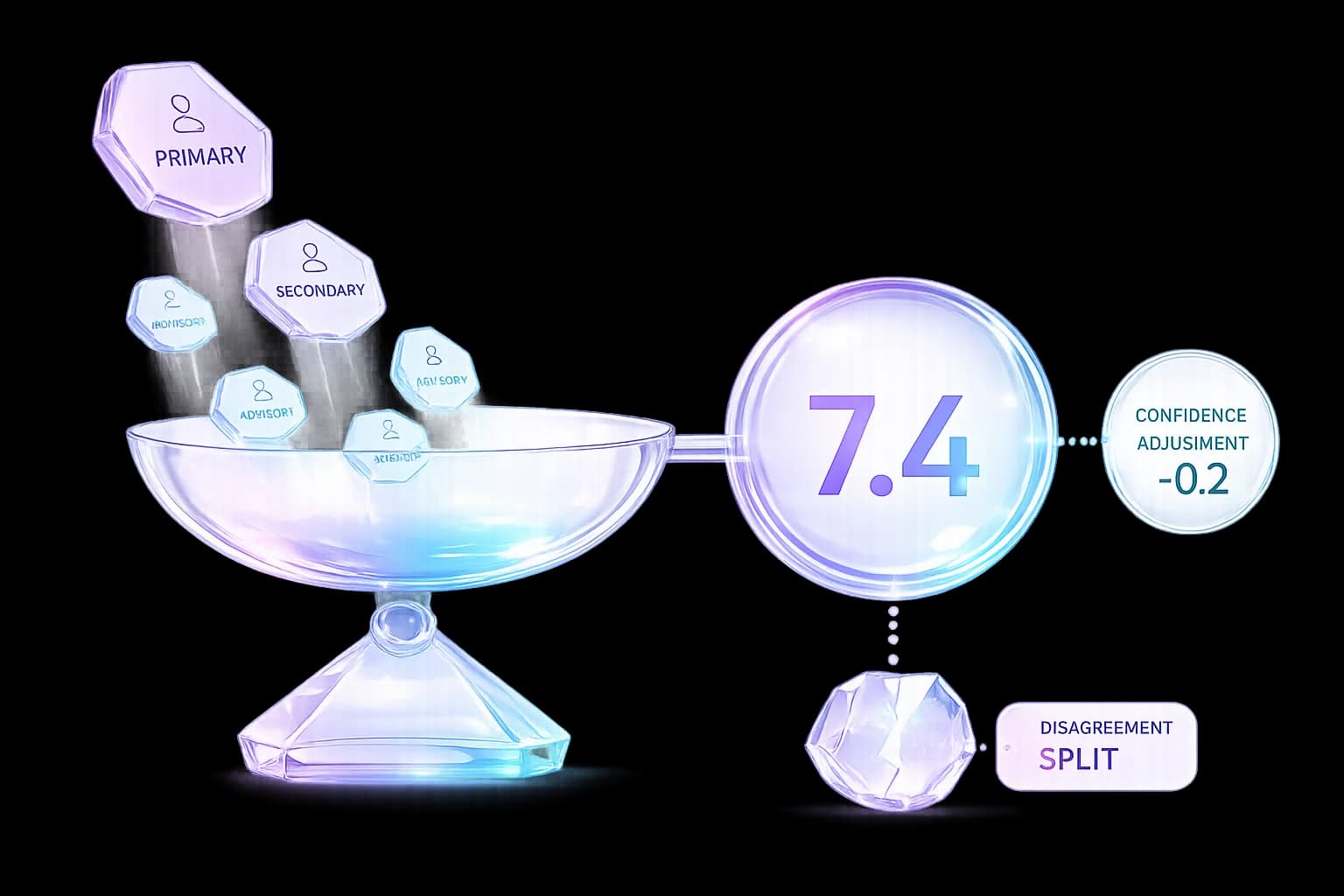
A fixed calculation combines judge outputs into an advisory AI Total Score. The same judge scores, routing weights, confidence values, and criterion weights produce the same result. The score informs human review but does not determine the final ranking.
- Criterion score
Per dimension
Judge scores are combined using routing weights to produce a weighted average. Inputs Judge score · routing weight · confidence Primary judges Carry the strongest influence Advisory judges Add context without dominating the score
- Confidence
Confidence adjustment
Confidence is calculated separately and can apply a limited downward adjustment. It reduces overconfidence when evidence is thin. Maximum adjustment: 15%.

- Total score
Across dimensions
Project weights combine the AI Criterion Scores into one advisory AI Total Score on a 0-10 scale.

- Review signal
Disagreement
Spread flags consensus, split, or conflict between primary and secondary judges. It does not change the score — it tells reviewers where to look closer.
- Reproducible math
Reproducible
No model call runs during final aggregation. The same judge outputs and weights produce the same calculated score every time.
Averages can hide the case that needs review
When judges disagree, EvalLens shows the spread instead of burying it in an average. Spread does not change the score. It points reviewers to the cases that need a closer look. The numeric tests live in Consistency & Reliability.
Strong, stable signal
Strong score, needs review
Opportunity with execution risk
Contested, not simply weak
AI prepares the evidence. You set the score.
The AI Total Score is an advisory baseline - it explains the AI read, but it never ranks the batch. The Jury Score is the final human scoring input, and the leaderboard is ranked only by that human score. Because no model runs at scoring time, the same judge outputs and weights reproduce the same baseline every time.
Review the evidence
AI suggests a score for each dimension and shows the evidence behind it — a read-only reference.
Add live context
Bring in what the deck can't show: notes from the live pitch and the Q&A.
Set the Jury Score
You set your own Jury Score per dimension. It stays a separate value from the AI Criterion Score — the AI baseline for one dimension.
Submit the decision
The leaderboard is built only from submitted Jury Scores. The AI Total Score never determines the ranking.
Prepares the review, never your judgment
EvalLens evaluates what is present in the deck, highlights missing evidence, and prepares the review. It does not prove that every claim is true.
Evaluates what the deck presents and flags what is missing — it does not verify claims against the outside world.
Gives decision support for reviewers, not a recommendation to fund or pass.
Never ranks the batch — the human Jury Score owns the leaderboard.
Describes the pitch today; it does not forecast whether the startup will succeed.


Follow one score from slide to final call
Open a sample evaluation and trace one score from slide evidence to rubric band, judge output, AI Total Score, and final Jury Score.