Just after 3 p.m. CEST on 17 September, the first founder went on air with a deck the jury had already read. Not skimmed between sessions. Read in full, slide by slide, with notes on which claim had no number behind it.
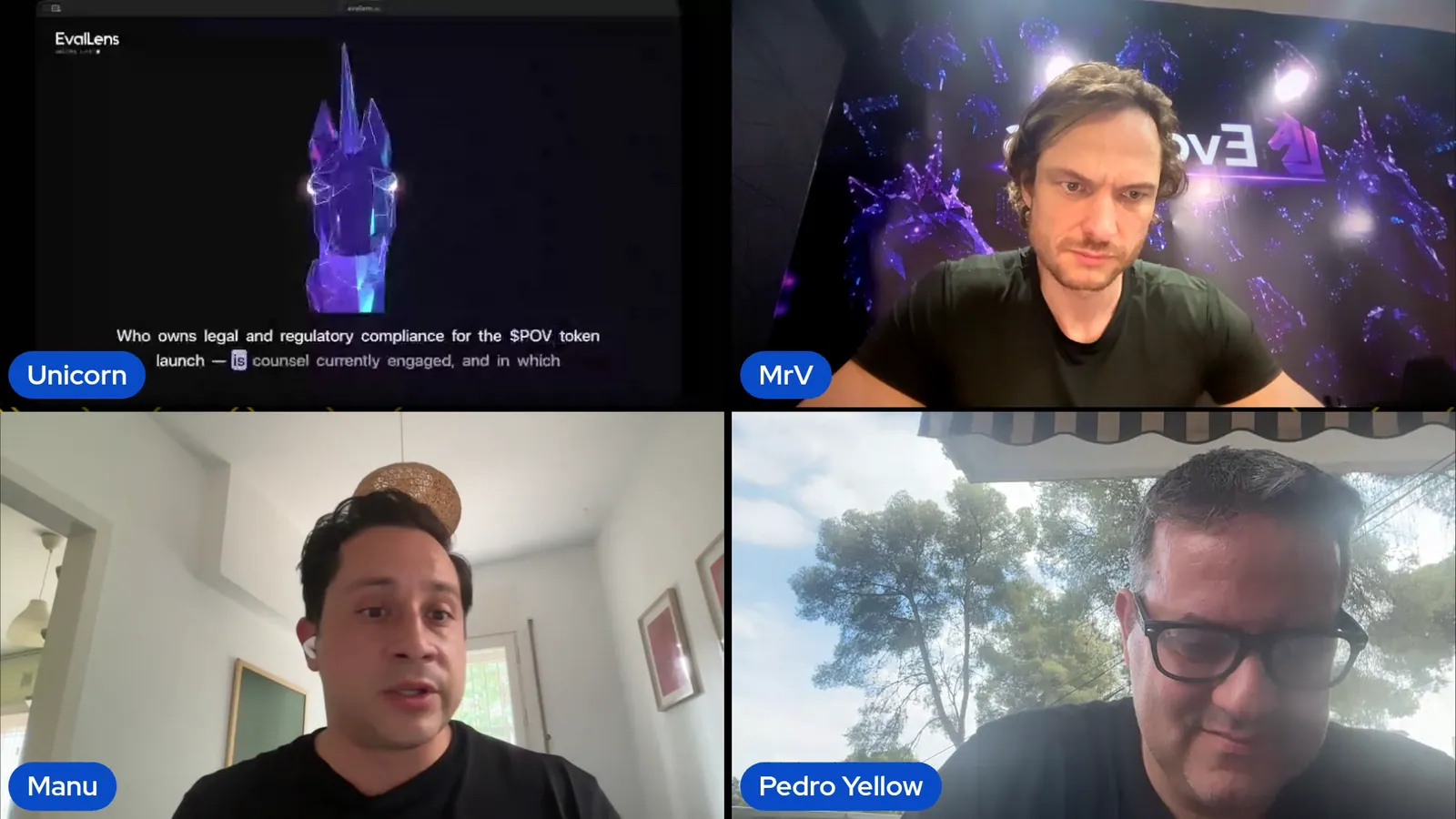
The jury was six AI judges. The host asking the follow-up questions was an AI too. This was Pitch Gauntlet: The Unicorn Verdict, an AI-judged pitch competition we ran with Yellow, CoinFerenceX, R2 Copilot and Genzio, live from a villa in Castelldefels, Barcelona, during European Blockchain Week.
The short version
Deck  →  6 AI judges  →  3-min live pitch
   →  2-min Q&A with the Anonymous Unicorn
   →  leaderboard, read out on air  →  report to every founder
Eight teams on stage. Six judges per deck. One report for every founder, winner or not.
Why founders leave demo days with nothing
Most demo days pay founders in applause. The feedback, if any, goes to the few who reach the stage.
Yellow's own 10X Founders Demo Day in August was the exception: the teams on stage got written feedback from a human panel. That takes a panel's evenings, which is why almost nobody does it.
Why don't VCs give feedback on pitch decks? Because they have no incentive to. A partner scanning hundreds of decks decides in seconds, explaining a pass takes time they don't have, and specific notes invite an argument. So founders get a polite no and guess at the reason.
We wanted a demo day where the feedback is the product and the ranking is the by-product.
How an AI-judged demo day works
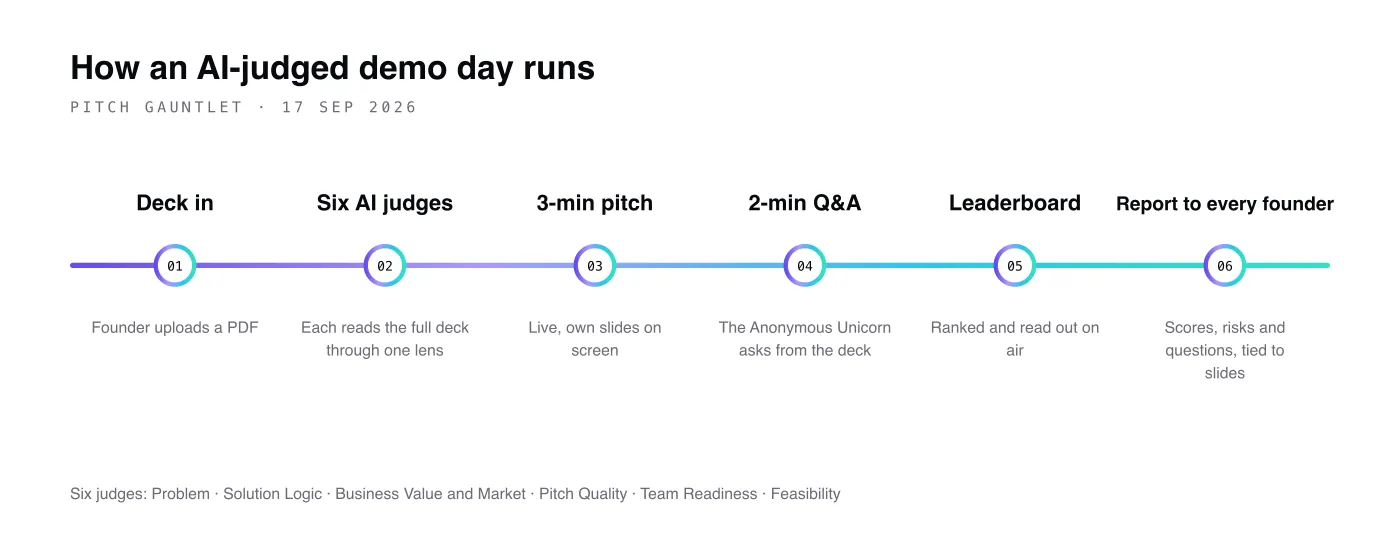
1. The deck gets read in full. Founders upload a PDF to the event page. Six role-based judges read the whole thing, each through a single lens. They run in parallel and never see each other's scores. Every conclusion cites the slide it came from.
| Judge | What it looks at |
|---|---|
| Problem | How real and how sharp the pain is, and what people use today instead |
| Solution Logic | Whether the idea holds together and how it differs from the alternatives |
| Business Value and Market | Market size and structure, monetisation, defensibility |
| Pitch Quality | Structure, clarity, whether each slide answers the question it raises |
| Team Readiness | Relevant experience, founder-market fit, ability to execute |
| Feasibility | Whether the plan, the resources and the timeline add up |
Scores land on six dimensions, weighted: Problem 15%, Solution 15%, Market 20%, Business model and GTM 15%, Team 20%, Feasibility 15%.
2. Three minutes on air. Pedro Miranda of Yellow hosted from the villa. Each founder pitched with their own deck on screen and their own hands on the slides.
3. Two minutes with the Anonymous Unicorn. The questions came from that team's own deck: the milestone marked "live" on one slide and "18 months out" on another, the retention figure with no customer count next to it. Nobody got a generic "tell us about your go-to-market."
4. The leaderboard. Ranked by score, read out on camera by the host.
5. The report. When the show ended, every founder who pitched could open the full read on their deck.
The whole show is on replay on X.
If you run a demo day
What it takes from an organiser: an event page, a deadline and your criteria. Founders upload PDFs. The judges read every deck within hours, with no panel to book. You get a ranked list with the evidence behind every score, and each founder gets their report. Book a demo and we'll walk you through the Pitch Gauntlet setup.
The numbers
| Submissions | 9 decks in 45 hours |
| Teams on stage | 8 |
| AI judges per deck | 6 |
| Live show | 1 hour 53 minutes |
| Reach of Yellow's announcements on X | about 98,000 views |
| Founders who left with a report | 8 of 8 |
| Partner gift per team | 12 months of R2 Copilot Business, valued at $9,990 |
Forty-five hours is not a typo. Nine decks came in, and every one of them was read in full before the show.
What the report actually says
Every team that pitched now has a report on the event page, visible only to them. It holds:
- A score on six dimensions, each with a confidence level.
- Strengths and risks, every one tied to a slide number.
- Questions to confirm live: the list an investor brings to a first call.
- Deck gaps: what the slides never say.
Read eight of these back to back and the same five problems keep showing up. They're worth checking in your own deck tonight:
- "Live" on one slide, "roadmap" on another. The same feature described as shipped and as an 18-month target.
- A strong metric with no denominator. Net revenue retention above 100% means little without revenue or a customer count beside it.
- A market chart whose bars don't add up to the headline figure printed above them.
- A team slide with one name on it. A large raise, several workstreams, no disclosed owners.
- A mechanism that's named, never shown. Five acronyms, no diagram, no screenshot, no before-and-after.
A jury rarely says these things to your face. A fund says them after you've left the room, to someone else.
The leaderboard
| # | Project | Founder | Score |
|---|---|---|---|
| 1 | CybeRisk OS | Javier Díaz Evans | 6.8 |
| 2 | Perspective AI | Manu Peña | 6.1 |
| 3 | thesystem next | Ozan Kayan | 6.1 |
| 4 | Nooba AI | Marc Olsson | 5.9 |
| 5 | Dissident | Patricio Ibarra | 5.3 |
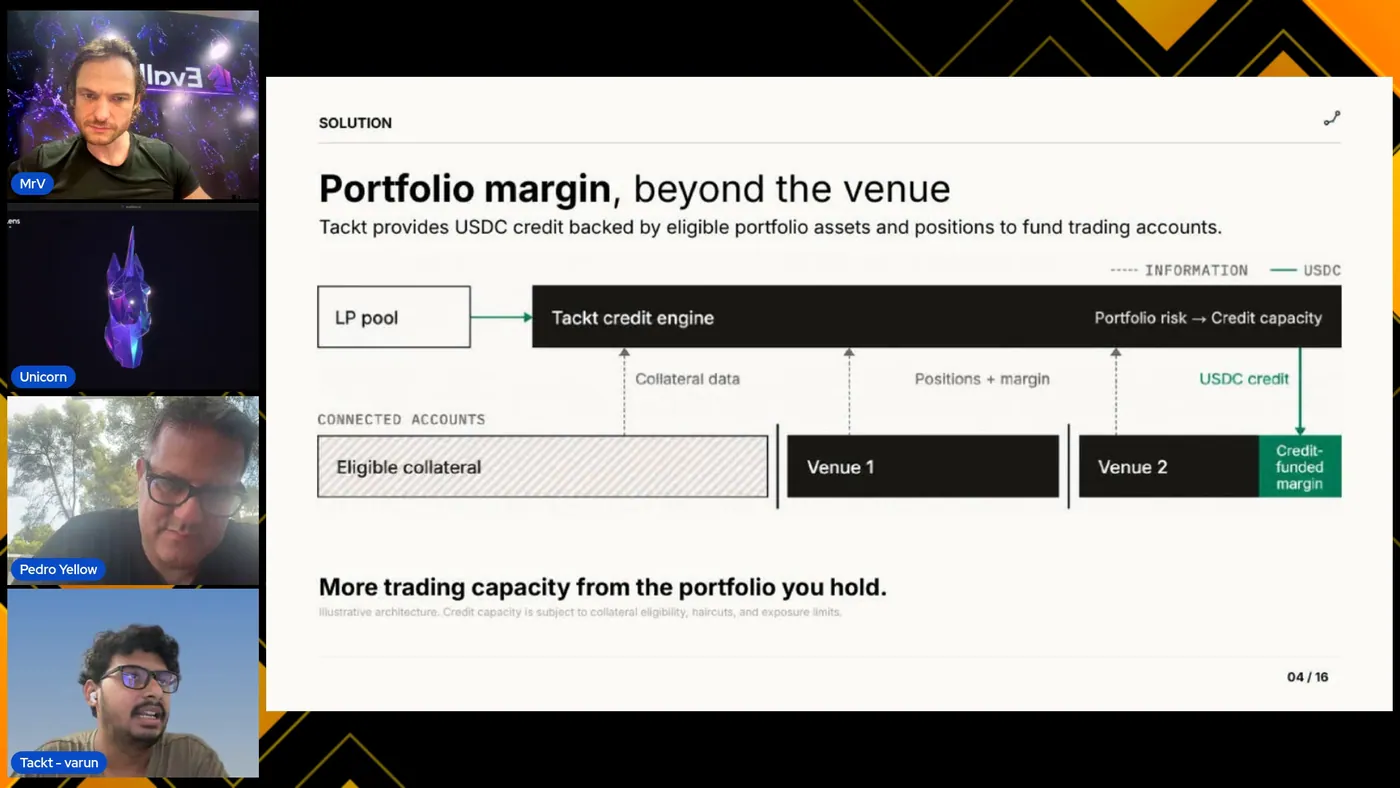
| 6 | Tackt | Varun L | 5.1 |
| 7 | Syncrate | Kizito Chukwuma | 4.5 |
| 8 | Web3os.world | Jose M Soler | 3.0 |
CybeRisk OS, an autonomous security operations platform from A3Sec built for the AI-agent threat era, took first place. Perspective AI, a user-owned AI marketplace, and thesystem next, a research-to-execution desk for systematic traders, tied on points behind it. (The Unicorn does not break ties on charisma.)
In their words
Pedro Miranda, Yellow: "We make a great team. I'm getting some amazing feedback about yesterday's event."
Den, R2 Copilot: "Today, one of a startup's most valuable assets is its moat […] The entire R2 Copilot team and I are happy to help you protect what makes your business valuable."
And from the replies under Yellow's recap on X: "Perspective AI and thesystem next both at 6.1… photo finish energy."
Who made it happen
Yellow organised the event, hosted it from the villa and carried it to its audience on X. Pedro Miranda ran the show on camera and brought the funds in. Tanishqa Mitra ran the founders' group, the announcements and the two-minute call before every slot. The show finished on schedule because of her.
EvalLens built the evaluation: the six-judge panel, the reports, the Unicorn's questions and the leaderboard. Vladislav Starodubov ran the platform and the AI host. Yaroslav Volovyi produced the stream.
CoinFerenceX, the Web3 summit in Dubai and Singapore, and Genzio, a Web3 marketing agency and incubator, took the Gauntlet to their communities.
R2 Copilot gave every team a 12-month Business subscription to its private AI workspace, up to 50 seats, whatever their place on the board.
Funds followed the pitches live, among them ArkStream Capital, Ape Ventures and FunFair Ventures.
What we'd keep
The read before the stage. The Unicorn came to every Q&A with the deck already taken apart, so two minutes went to the real gaps. After the show, founders opened the report and found the same questions there, with slide numbers.
Questions from the founder's own deck. A slide number beats a score. A 6.1 tells you where you stand. "Slide 5 names five acronyms and shows no mechanism" tells you what to do on Monday.
One studio, decks loaded in advance. One scene per founder, a backstage queue, no screen sharing. Boring, and exactly what a live show needs.
When should an AI make the final call?
Rarely. And only when everyone agreed to it first.
Our default hasn't moved: AI prepares an evidence-backed analysis, and a person makes the decision. In Nha Trang, a room of people overruled the system more than once, and that was the point.
Pitch Gauntlet was designed the other way round, and announced that way. Yellow wanted a format with no panel to book and no scoring sheets to reconcile at midnight. We agreed on one condition: if the machine judges, it shows its work to every founder, not just the winner. Where a jury, a committee or a fund is the one signing, the final call stays theirs.
An AI verdict is a format. It is not a philosophy.
What's next
Yellow closed its recap with "See you at the next Gauntlet." So will we. Before then, founders will see in their EvalLens dashboard whether they made the shortlist and why, the Anonymous Unicorn gets a better voice, a sharper script and the manners to let a founder finish, and the show gets shorter.
If you run a demo day, an accelerator cohort or a hackathon and want every team to leave with a report on their deck, book a demo. If you're a founder who wants to see how your deck reads before anyone scores it for real, try the live demo.
By that evening, every founder who pitched had a full read on their deck. Most founders don't get one in a year of pitching.
Common questions
What is an AI-judged pitch competition? A pitch competition where AI judges, not a human panel, read the decks, ask the questions and produce the ranking. At Pitch Gauntlet: The Unicorn Verdict on 17 September 2026, six role-based AI judges read every deck in full, an AI host called the Anonymous Unicorn asked each founder questions drawn from their own slides, and the host read out the resulting leaderboard on air.
How does an AI score a pitch deck? At EvalLens, six judges each read the whole deck through one lens: Problem, Solution Logic, Business Value and Market, Pitch Quality, Team Readiness and Feasibility. They work in parallel without seeing each other's scores and cite the slide behind every conclusion. Scores land on six weighted dimensions, from Problem significance (15%) to Market attractiveness and Team fit (20% each).
Why don't VCs give feedback on pitch decks? Mostly time and incentives. An investor reviewing hundreds of decks decides quickly, explaining a pass costs time with no upside, and specific notes tend to start an argument. The practical answer for founders is to get a structured read before the pitch, from a reviewer or a tool that ties every comment to a slide.
Who won Pitch Gauntlet: The Unicorn Verdict? CybeRisk OS (Javier Díaz Evans, A3Sec) finished first with 6.8 out of 10. Perspective AI (Manu Peña) and thesystem next (Ozan Kayan) tied for second on 6.1. Eight Web3 teams pitched; the event was organised by Yellow with EvalLens, CoinFerenceX, R2 Copilot and Genzio.
Does EvalLens always let the AI make the final decision? No. The default is that AI prepares an evidence-backed analysis and a person, a jury or a fund makes the final call. Pitch Gauntlet was a format designed and announced as AI-judged end to end, on the condition that every founder receives the full report behind their score.