Every deal fully read before screening night. Every judgment still your members.
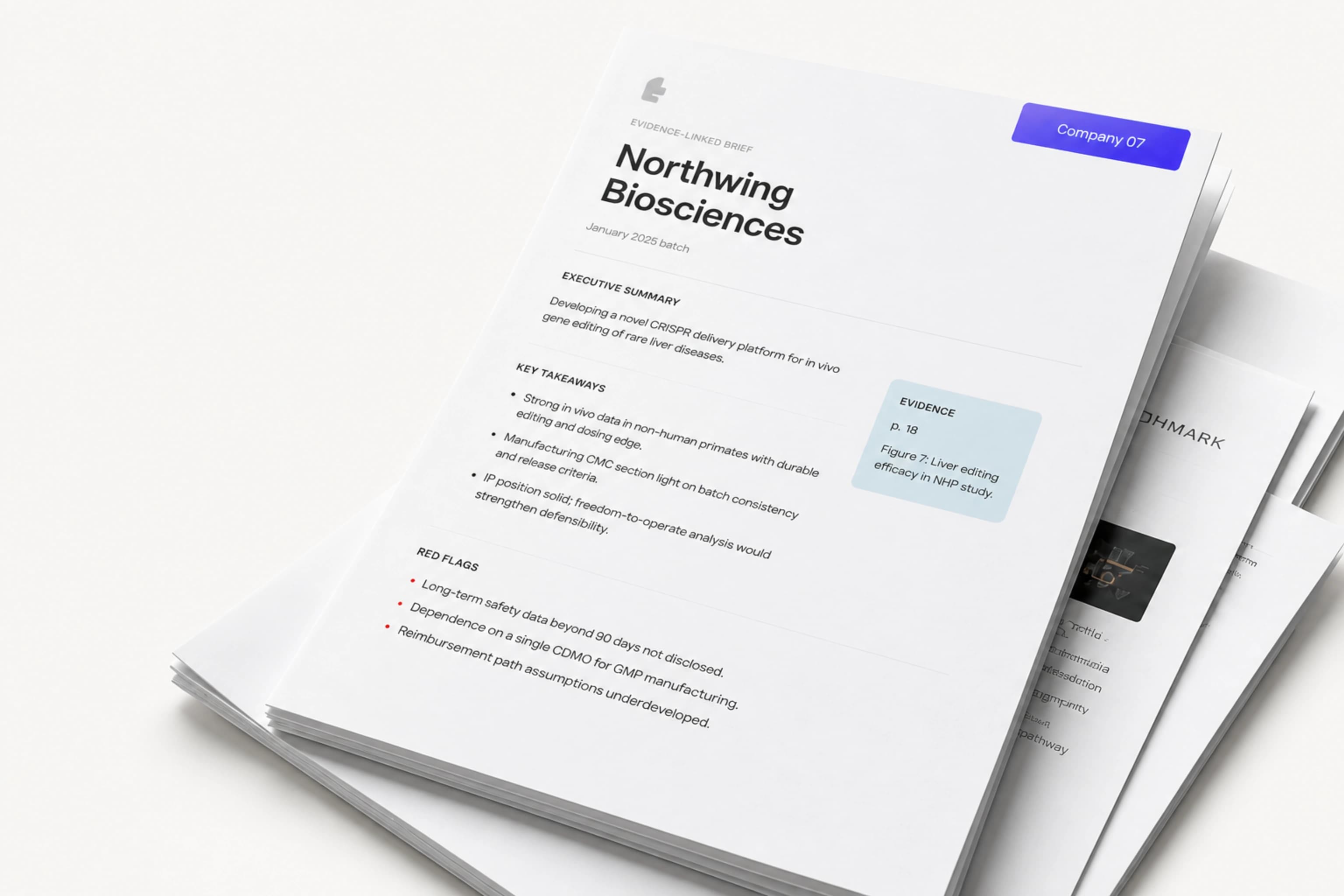
EvalLens reads the whole monthly batch and hands your screening committee a one-page, evidence-linked brief per company — findings, red flags, quotes with page references, and the questions worth asking in a ten-minute pitch. Your Dealum or Gust pipeline stays exactly where it is.
And volunteer hours are exactly what's scarce
- 10–40/modeal applications, depending on group size — pre-screened by one staffer or the volunteer who drew the short strawthe pilot measures yours
- “Beg & plead”the ACA's own deal-screening best-practices guide on filling the screening chair. It's not just your groupACA guide
- 3–4 motypical angel-group cycle from first contact to wire — while streamlined groups close in ~45 days. Founders noticeCarta
- 6–8 wksof member-volunteer due diligence per deal — the range angel-group guides themselves publish — starting every time from a blank pageangel-group guides
This is how good groupsquietly hollow out.
The spiral starts — or stops — at screening speed. Founder guides now openly advise skipping angel groups over process length. Groups that answer founders in days — with evidence, not silence — keep the deal quality that keeps the members. The brief is how the meeting stays worth the dues.
- 01Slow screening
- 02Strong founders skip the group
- 03Weaker deals at the monthly meeting
- 04Members see mediocre dealflow
- 05Renewals dip · best members drift to syndicates
- 06Fewer volunteers
- 07Screening gets slower
Seven steps from application to investment screening
Every application becomes a screening-ready, evidence-linked brief. Every decision stays with your members.
- 01
Plug into the pipeline you already run
Deals keep flowing through Dealum, Gust or your intake form — batch in, briefs out. No migration, no new system for members to learn. You get: zero workflow change.
- 02
Applications arrive complete
Incomplete submissions are flagged with exactly what's missing — founders chase themselves instead of your staff chasing founders. You get: hand-holding hours back.
- 03
Every deck fully read — by AI reviewers, named honestly
Independent AI reviewer lenses — team, market, traction, terms-readiness — read every page of every deal against your criteria. Not people: adversarial reads that can't anchor on each other, applied identically to deal #1 and deal #30, whichever volunteer would have drawn them. You get: the pre-screen done by Tuesday morning.
- 04
A one-page brief per company
Findings, red flags, unverified claims and quotes with page references — plus the questions worth asking after a ten-minute pitch. One page a busy member actually reads. You get: comparable grounds for who presents.
- 05
The chair runs a meeting, not a reading marathon
The screening committee picks the presenting companies from briefs. The job nobody wants shrinks to the part people actually enjoy — and the seat gets easier to fill. You get: a screening chair who says yes again.
- 06
Deliberation with disagreements on the table
Where reviewer lenses split on a deal, the gap is flagged as an open question — exactly what member deliberation is best at. Nothing is silently averaged, and every investment decision stays individual, member by member, as it always was. You get: sharper meetings, gold sheets that write easier.
- 07
The deep dive starts from the brief
Your deal lead opens the deep dive with red flags, unverified claims and verification steps already itemised with page references. When a deal syndicates across chapters, the same evidence record travels with it. And every founder who doesn't advance gets a decline-with-reasons note — reviewed by your deal lead before it's sent — in days, not weeks. You get: DD from week three, syndication on one standard.
What your committee getsbefore screening night.
One page per company: the evidence, what it means, what is missing, and what your committee should ask next.
- Evidence
The exact claim, linked to its source.
“…$41k MRR across 11 accounts…” · page 7
- Finding
What the evidence means against your criteria.
Revenue is recurring and concentrated: top-3 customers are 68% of MRR.
- Risk
What the deck does not prove.
Customer concentration is not addressed anywhere in the deck.
- Next step
What the committee should ask or request.
Request a cohort revenue breakdown for the deep-dive agenda.
- Optional score
Context using your criteria and weights.
Advisory only. Members judge; the score never ranks a deal for them.
“If the machine reads, what do my members do?”
More of what they joined for. Screening and DD seats stay — the grunt-reading goes. Engagement shifts from skimming thirty decks to debating four good ones. The meeting gets better, and the meeting is the product members renew for.
Seats stay
Screening committee, deal leads, DD teams — every member role survives. What changes is what the role costs in Tuesday nights.
The perimeter you can't see today
Your members are already pasting founder decks into personal AI accounts you can't govern. This puts the reading inside a perimeter you control — no training on decks, retention on your policy.
Founder reputation
Fast, evidenced answers — including declines, approved by your team before sending — make founders recommend your group. That's next month's dealflow quality.
Priced for a volunteer-run budget.One small parallel batch to start — this month’s deals, run alongside your pre-screen. If the briefs earn their seat at the screening meeting, they stay. Failed runs never billed. See pricing or book a call.
Want more? Ask the harder questions.
See how EvalLens fits your existing pipeline, keeps every finding traceable to the deck, protects founder data, and leaves every investment decision with your members.
What your board will ask
- Our members join to exercise their own judgment.
- And that's what this protects. Nobody joined to spend Tuesday nights skimming thirty decks — they joined for the debate, the pitch, the deal. The AI reads; members do more judging than before, on better material. Screening, presenting and every individual investment decision stay with people.
- Dealum already has AI features.
- It does — extraction and pre-filling, and it's good workflow. What your platform's AI doesn't do is hand your screening committee an evidence-linked, page-referenced brief per company on your criteria, with disagreements flagged. Keep the pipeline; add the reading layer on top.
- What if the AI invents something about a deal?
- Quotes are verified against the deck before a finding stands — no quote, no finding. Thin evidence moves conclusions down, never up, and gaps are flagged as questions for the committee rather than papered over.
- Are founder decks confidential?
- Closed perimeter, processed only for your group's screening, never used for training, no public links — with retention and deletion on your policy. Compare that honestly with members running decks through personal chatbot accounts today.
- Every chapter screens differently.
- Criteria and weights are configured per chapter — and the network gains one comparable evidence standard underneath, which is exactly what makes multi-chapter syndication trustworthy.
- Who else uses this?
- We're building with a founding cohort of groups — which is why the entry point is one parallel batch on your own deals, not a logo wall. Your screening chair sees the briefs next to the volunteer pre-screen and judges for herself.
This month's batch, in parallel.
30 minutes with your screening chair or executive director: we map your criteria and run one month of deals side by side with your pre-screen. Nothing about your process changes. Angel networks get the first run free through October 31, 2026, on batches of up to 10 decks.