A founder I know had a beautiful deck. A $40B market on slide three. A sleek architecture diagram with the word "AI" in three places. Five advisor logos, all recognizable. It ranked in the bottom third of its batch.
The deck that beat it looked plain. No gradient backgrounds, no wall of advisors. What it had was a named customer, a real number next to that customer, and one slide that said exactly how the product worked. Every claim on it pointed at something you could check.
That gap — between a deck that looks convincing and a deck that is convincing — is the whole game once your pitch gets scored on a rubric. This is a field guide to closing it.
Stop pitching the person. Start pitching the stranger.
It's tempting to file that result under "style lost to substance," nod, and move on. That's not quite it. The pretty deck didn't lose for being pretty. It lost because ambition had quietly replaced evidence, and a rubric counts evidence.
A structured evaluation does something a hallway conversation can't: it refuses to be charmed. It reads what's on the slide, scores it against a fixed standard, and writes down why. You're not pitching someone who might like you. You're pitching a stranger who will never meet you and only believes what you show them. More and more often, that stranger is part software — a panel of AI reviewers that prepares the analysis before any human sees your deck.
There's a plain reason the read keeps getting more structured: volume. A firm can look at a hundred decks for every check it writes (GoingVC), and nobody reads a hundred decks generously. Structure is how the strong ones stop getting missed.
That sounds colder than it is. It's actually the most level playing field a founder ever gets. The stranger has no bias about where you went to school and no memory of the last founder who oversold. It has a rubric. Learn what the rubric rewards, and you can earn a score you didn't have to hope for.
One line holds the whole guide together:
A claim is only worth the evidence a stranger could verify without you in the room.
How the scoring actually works
Before the six dimensions, three mechanics decide more than most founders realize.
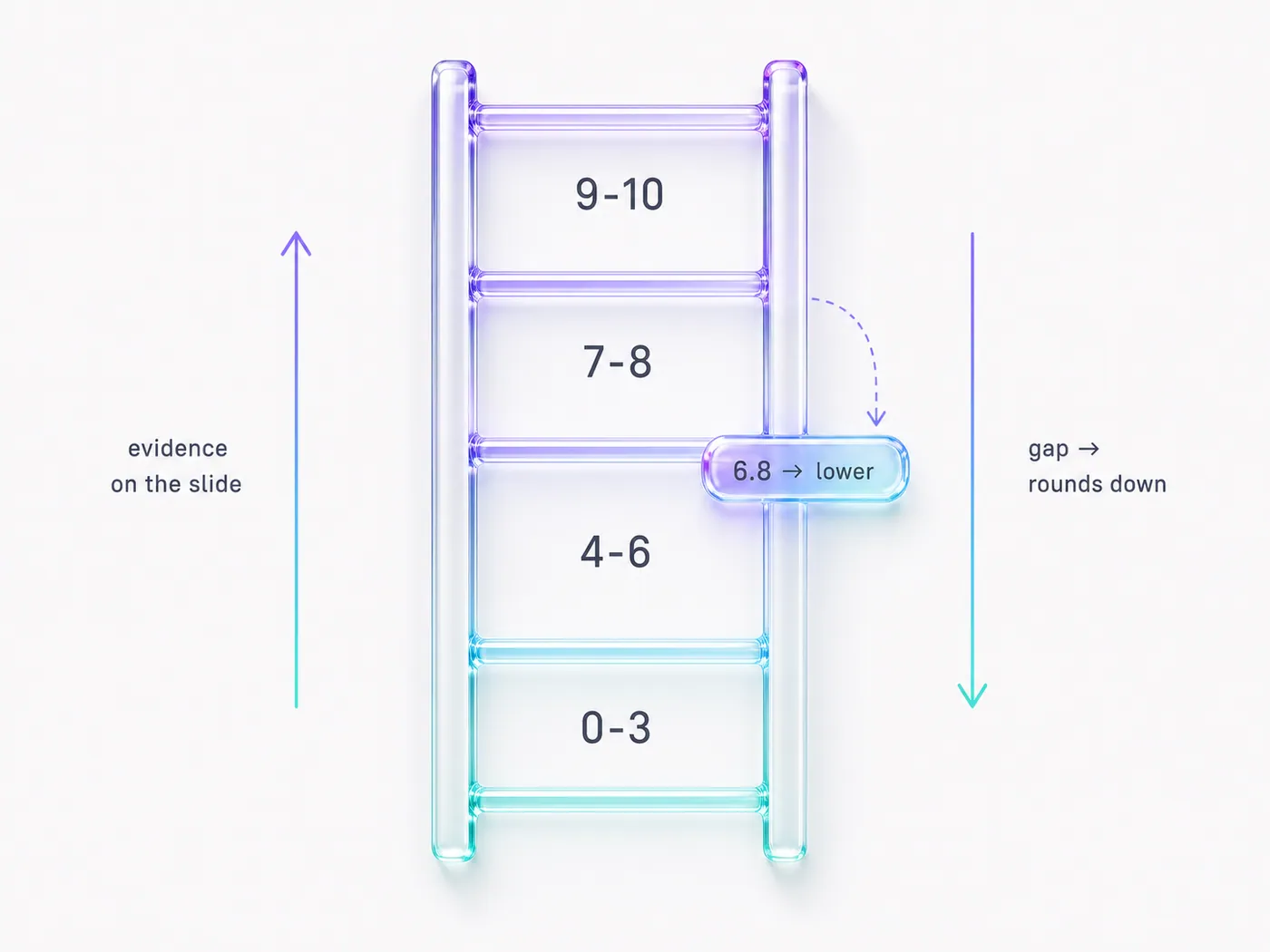
Evidence moves you up. Gaps round you down. Each reviewer is required to tie every judgment to something on a slide — a fact, a number, a quote, with the slide cited. No reference, no claim. And when the evidence for a dimension is thin or missing, the score doesn't hover hopefully in the middle. It rounds toward the lower band.
Evidence on the slide   → the score can go up.
No evidence, or a gap    → the score rounds down.
Thin evidence doesn't just fail to help — it multiplies you down. Every dimension carries a confidence level, set by how complete the evidence is. When a reviewer can't find enough to be sure, the whole dimension is scaled down — by as much as 15%. A strong claim with nothing behind it is worse than a modest claim you prove.
One reviewer isn't scoring your business at all. It's scoring whether a stranger can find your key facts without guessing. If your best traction number is real but buried on slide 19, that reviewer reads it as missing — and so will a busy human, who spends two to four minutes on the average deck and never reaches the last slide of nearly half of them (DocSend). Findable beats thorough — clarity isn't decoration here, it's a scored dimension of its own.
Put those together and you get the reason you can't game any of this: run the same deck through twice and you get the same score. There's no lucky day and no reviewer you won over. The only way up is to put more on the slide.
The six dimensions, and what each one rewards
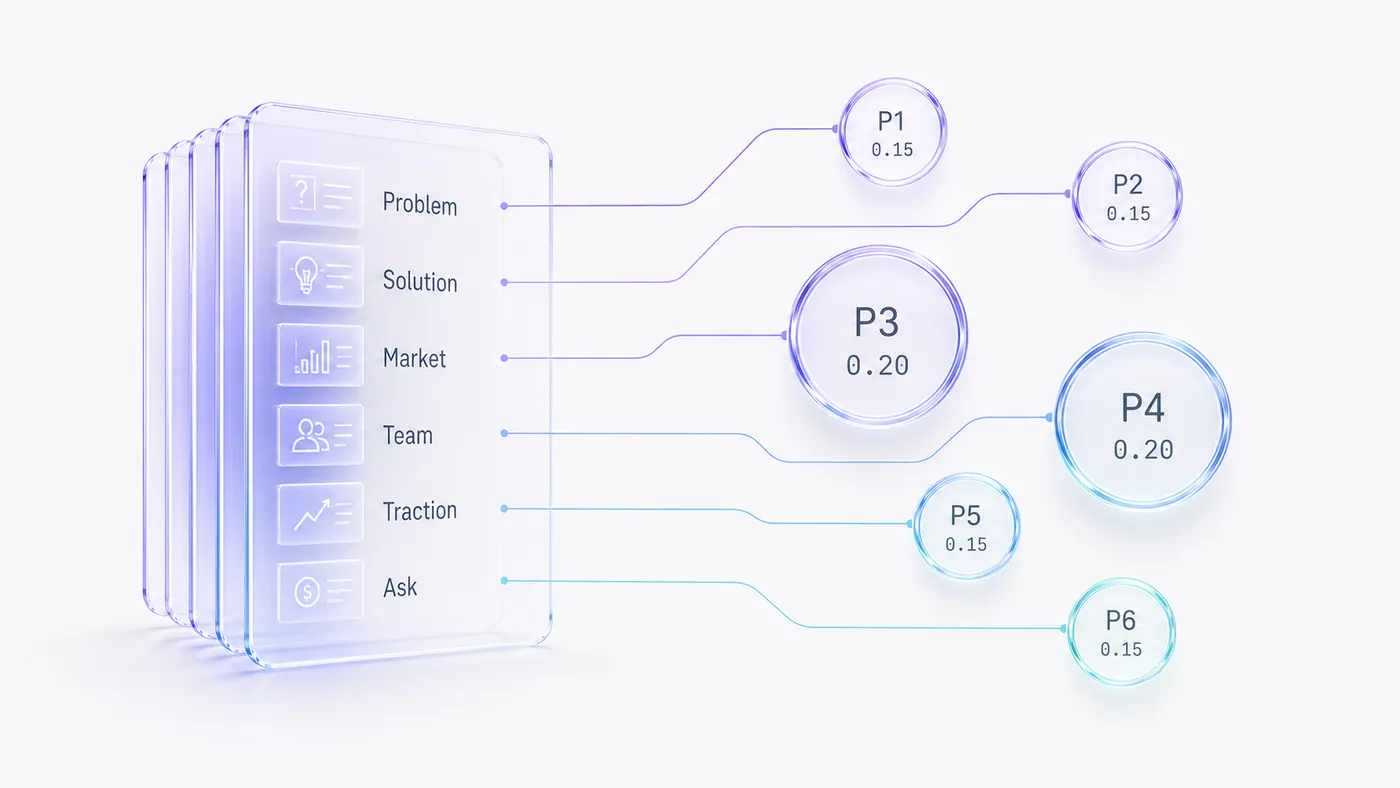
A pitch is scored on six dimensions. Two of them — market and team — carry more weight than the rest, so a thin slide there costs you more. That weighting isn't a lab invention. When DocSend tracked where investors actually spend their few minutes, the team slide drew the most attention and the product slide the least — and by 2024, time on the team slide had jumped again as funds "prioritized people" (DocSend, 2024 report). The rubric points where the money already looks.
| Dimension | Weight | Show this | On which slide |
|---|---|---|---|
| Problem significance | 0.15 | A named user, how often the pain hits, what it costs | Problem |
| Solution differentiation | 0.15 | One clear mechanism and the thing rivals structurally can't copy | Solution |
| Market attractiveness | 0.20 | A reachable beachhead, who actually pays, a path to first customers | Market |
| Business model / GTM | 0.15 | A real price for the real buyer and a first channel | Business model / GTM |
| Team / founder fit | 0.20 | Each founder's link to this problem, and something you've shipped | Team |
| Feasibility / readiness | 0.15 | Sequenced milestones, matched resources, named risks | Roadmap |
The point of splitting a deck into six isn't bureaucracy. It's that a good story can't paper over a weak number. Strong team, thin market — the report keeps those apart, and so should you. Here's what the top of each band actually asks for.
Problem — make the pain expensive to ignore
The top band isn't for a big problem. It's for a specific, frequent, costly pain, tied to a named user, with a credible reason it matters now — and a sign that current alternatives visibly fail that user. Your problem slide should name one real user, say how often the pain hits and what it costs them, and show it rather than assert it: a quote, a workflow, a number a reader can point at.
Red flag: a problem described only in the abstract with no named user, or "huge market, therefore big problem." A rubric reads that as a solution in search of one.
Solution — one mechanism, clearly better
A high score wants a coherent solution with a clear mechanism and a genuine, defensible difference — ideally a sharp, non-obvious insight that changes the user's outcome. On the solution slide, say how it works in one line, then name the one thing you do that others structurally can't. Novelty for its own sake doesn't score. Novelty tied to the problem does.
Red flag: feature soup with no core, or a "difference" that's really just branding. If the mechanism wouldn't relieve the pain from your problem slide, the two slides contradict each other, and the reviewers see it.
Market — size it from the bottom up
Market carries the heaviest weight, and the top band goes to a well-sized, reachable market with a clear segment, a credible entry motion, and a believable path to first customers — a sharp wedge with real demand behind it. Show a beachhead you can actually reach, name who pays, and explain how you land the first ten. Not a top-down slice of a trillion-dollar TAM.
Red flag: "1% of a $B market" with no entry segment, sizing that ignores who actually pays, or a segment you'd have to educate from zero. Investors have seen the top-down slide too many times to be moved by it — one VC roundup notes the calculation "takes 30 minutes and proves nothing about actual customer acquisition" (Vestbee).
Business model — price to the buyer, not the spreadsheet
The rubric rewards clear monetization, pricing that makes sense for the person actually paying, and a credible go-to-market with a beachhead. The best decks show monetization that reinforces defensibility and a motion that compounds — referrals, data, or network effects that make each new customer cheaper to win. Put a real price on the slide and name the first channel.
Red flag: "we'll figure out pricing later," a price aimed at the wrong payer, or a GTM that tries to be everywhere at once with no first beachhead.
Team — connect the founder to this problem
Team weighs as much as market, and the score is about execution and fit, not pedigree. The top band is a capable, reasonably complete team with clearly relevant experience and tight founder-market fit — a real reason this team builds this thing. Tie each founder's background to the problem, show something you've already shipped, and name the gap you're hiring for.
Red flag: credentials standing in for evidence of execution, founder-market fit asserted but unsupported, or critical roles missing with no plan. Logos aren't fit.
Feasibility — a plan that admits risk
Feasibility scores execution realism: a credible, well-sequenced plan with resources that match the ambition and risks named out loud. The highest band has clear milestones, sensible resourcing, and a sober view of dependencies. It runs against instinct, but naming what could go wrong scores better than a roadmap where nothing does.
Red flag: a plan that assumes no setbacks, ambition wildly out of line with resources, or ignored dependencies — regulatory, technical, partnership — that quietly gate everything.
Before you submit: the checks that sit under all six
Three habits raise every dimension at once.
Fill the ten sections. The system reads your deck as ten parts — problem, solution, market, business model, traction, team, roadmap, financials, ask, and whatever's left over. A missing major section is flagged as a hole; a section that's present but thin is flagged too. Completeness is the floor you stand on before quality is even measured.
Make every number traceable. A metric with no source is a metric the rubric discounts. Tie each claim to the slide that earns it, and put the proof next to the number, not in an appendix nobody reaches.
Build for the floor, not the ceiling. Because the score is reproducible, you can't win on a good day. Assume the least generous honest reading of every slide, and write so that reading still lands you in the band you want.
The machine shortlists. A human still decides.
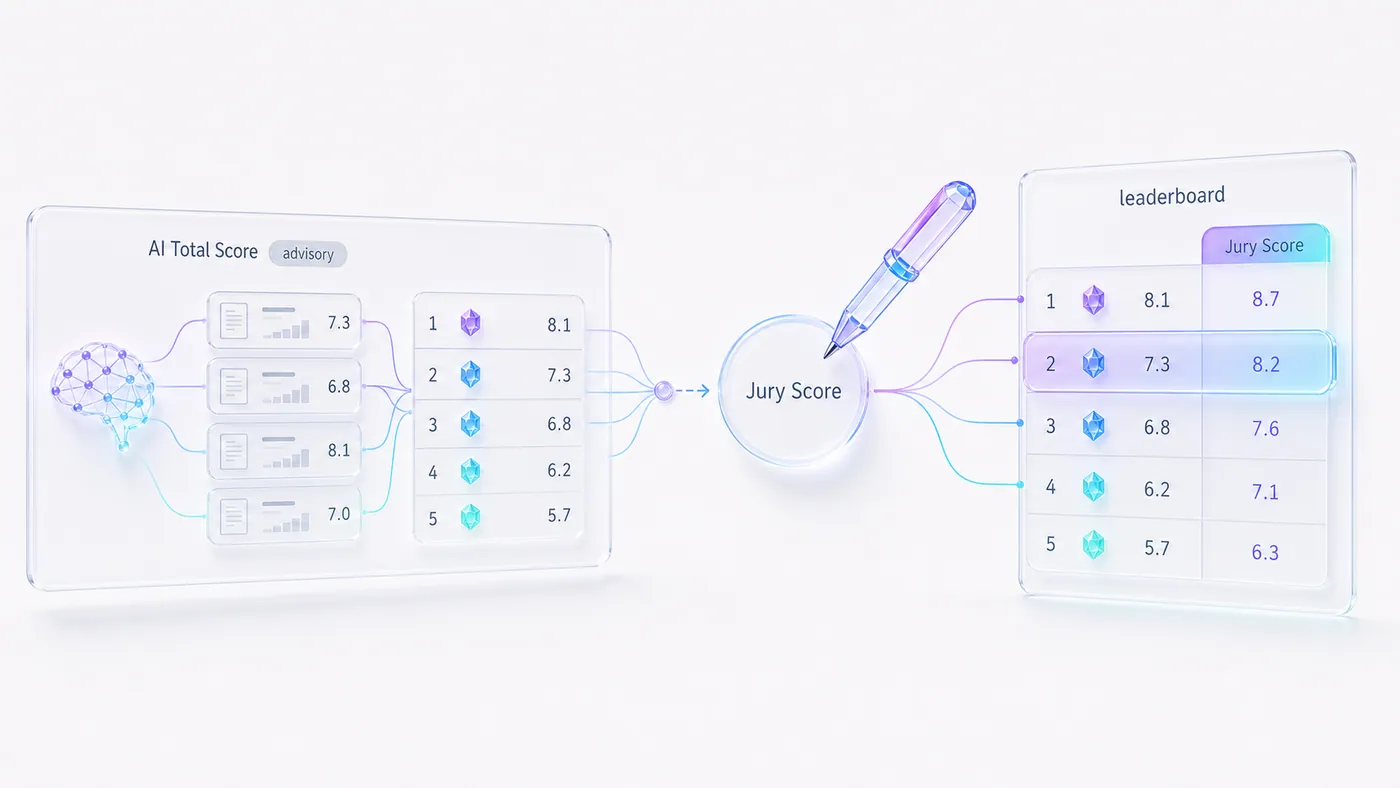
Here's the part founders miss. The AI panel doesn't hand down a verdict. It scores each dimension, shows its evidence, and writes the questions a reviewer will put to you live. Then a person sets the final score, and the ranking is built from that — not from the AI's number, which stays on screen only as a reference.
So your deck earns the shortlist; the room earns the win. Two things follow. Write the deck to survive a cold, literal read — that's what gets you into consideration. Then prepare for the questions that read will raise, because a real person, holding the AI's analysis, makes the final call. Across more than 1,000 evaluation runs, the decks that climb are rarely the prettiest. They're the ones that leave a reviewer nothing to guess.
Reviewers forgive an ugly slide. They rarely forgive a number they can't check.
Want to see how your deck reads before anyone scores it for real? Try the live demo and run it through the lens yourself. Running a batch of your own? Book a demo.