
Review the evidence. Submit your own judgment
Judging a pitch competition means scoring each team against the same agreed criteria, using the evidence in the deck and the answers in Q&A, independently of the other judges. AI findings and source references support your reading; the vote you submit is your own assessment.
What you getA submitted criterion-level vote, with relevant comments and answer notes.
Illustrative interface. Docsbook report shared with permission; other participants, judges, votes and rankings shown here are fictional. Interface excerpt
Pitch programmes01. Accept the invitation with the right account
Sign in with the email the invitation went to. Judges score; Viewers read without voting.
If the account does not match or the invitation has been revoked, contact the organiser. Access to another competition does not automatically grant access to this one.
02. Read the report alongside the submitted evidence
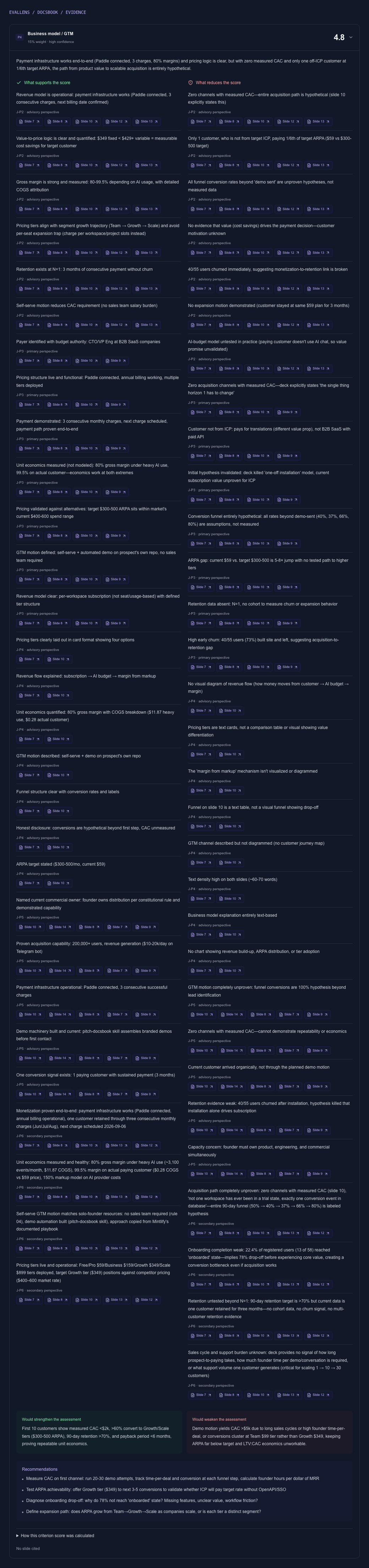
Start with Summary, then open AI report for criterion findings and sources. Check the slides, not just the score.
The AI Total Score is advisory. Check the method and weights and decide whether the findings are supported by the material. The recorded Docsbook excerpts illustrate a report.
03. Ask the important questions and keep notes
Prepare the discussion in Questions and note the answers. Keep what was said apart from what the deck shows.
Answer notes preserve useful context; they are optional and do not replace completing the required score fields.
04. Complete the criteria and submit your vote
Score every required criterion in Your vote and add a comment. A draft does not count until you submit.
If you change a submitted assessment, check its updated submission status. The organiser handles final confirmation, exceptional votes and publication. Your Judge role does not grant those organiser controls.
Review and score
Business model / GTM
Jury ScoreFinal Score
SubmittedCalibrate your judges before scoring
Judges who read the same pitch often score it differently. In a business-school startup competition, individual investor judges scoring the same business plans agreed at an intraclass correlation of 0.25, where 1 would be full agreement (Csaszar, Ketkar and Kim, 2024, figure from the preprint). A short calibration before the event narrows that gap:
- Every judge scores the same two or three decks on their own, using the competition's criteria.
- Compare the scores criterion by criterion and talk through the largest gaps.
- Agree in one sentence what strong, medium and weak evidence means on each criterion.
- Repeat the exercise when a new judge joins the panel.
Training raters on a shared picture of each score level improves their accuracy, a meta-analysis of frame-of-reference training found (Roch et al., 2012). The judging rubric guide has anchors you can start from.
Score alone, then discuss
Submit your own criterion scores before you see anyone else's. In field experiments with 369 evaluators, judges who saw other judges' scores moved down after harsher scores more than they moved up after kinder ones (Lane et al., 2022).
Ask every team the same kinds of questions. At TechCrunch Disrupt, investors asked women founders more questions about risks and men more about gains, and each extra risk question was linked to less funding later (Kanze et al., 2018). The questions in the AI report come from each deck's evidence gaps and give every team a comparable starting set.
A wide split is not always a mistake. Across 67 venture competitions, more disagreement among judges went with more later success, especially for unusual ventures (Gius, 2025). Write down why your score differs, so the organiser can see the reason.
Common questions
What do pitch competition judges look for?
Most competitions score the problem, the solution, the market, the business model and go-to-market, the team and feasibility, and live rounds often add delivery and Q&A. Score what the deck and the answers show, not how confident the pitch sounded. The judging rubric guide lists the six Pitch dimensions with questions for each.
How should a judge score a pitch?
Read the deck and the AI report before the pitch, score each criterion on your own right after the pitch and Q&A, and add a short comment where your score is high, low or far from the AI's. Submit before you discuss with the other judges.
Should judges see each other's scores before voting?
No. Seeing other scores first pulls judges toward the harshest one. Score alone, submit, then use the score spread to decide what to discuss.
How can judges avoid bias in Q&A?
Ask every team the same kinds of questions, about evidence and growth as well as risk, and keep what was said apart from what the deck shows. The questions in the AI report give every team a comparable starting set.
What should a judge do with the AI report?
Use it to find the evidence and the gaps faster, then check the cited slides yourself. The AI Total Score is advisory; your criterion scores are your own and form the Jury Score with the other judges' votes.
Can a judge change a score after submitting?
Yes. If you change a submitted assessment, check its updated submission status. The organiser handles final confirmation, exceptional votes and publication.
Can a judge see the AI score while voting?
Yes. In the voting window the AI Total Score appears as a read-only reference. It stays a separate field and does not count toward the Jury Score.
Need help with your invitation?
Contact your event organiser with the competition name and your invited email. They manage invitations, roles and the voting deadline.
EvalLens commercial calls are for organisers considering the product or a configured programme.