
What the Booker Prize taught our AI jury
Our AI jury sealed a Booker Prize 2026 pick and missed the winner by one place. Here is what the miss, the models' memory and one bad method taught us.


On 24 October we sealed an AI jury's pick for the Booker Prize 2026: The Disappearers by Marlon James. On 9 November the Booker panel chose The End of Everything by M. John Harrison. Our jury had Harrison second.
The full ranking, the sealed files and the hash check live in the first article. This one covers what the experiment taught us, including the parts that went badly.
The short version
1. You can't test an AI jury on past years. The models remember the winners.
2. A sealed forecast is the clean test, and one result is one data point.
3. We missed by one place. Before the penalty the gap was 0.43 points.
4. Our second method agreed with itself and did worse than chance.
5. The bookmakers backed the same book. Harrison was 4/1.
6. AI can prepare the analysis. People still make the call.
How the jury and the seal worked
Seven AI judges, split across two model families (Claude and GPT), scored six books. Each judge had one narrow job: language and form, conception, people and feeling, timing, critical consensus, the likely taste of this year's panel, and a Skeptic who could only subtract points. Every judge ran three times and had to quote evidence from a book card of about 800 words, built from the Booker site and published reviews. No judge saw the novels.
We wrote the rules into a protocol and hashed it on 23 October, before the final run. A script turned the scores into a ranking with fixed arithmetic. We sealed the result on 24 October at 04:03 UTC and published only its SHA-256 on 5 November. After the announcement we published the files, and the hashes match.
The seal is what makes the rest of this article worth reading. We couldn't move the pick after 9 November, so every lesson below comes from a result we couldn't edit.
You can't test an AI jury on the past
We planned to tune the jury on the 2024 and 2025 shortlists and check it on 2023. A cheap test killed that plan. We gave both models cards for the 18 books from 2023 to 2025 with the author names removed. Both models recognised every book and knew every winner.
So a backtest would measure memory. A jury that "predicts" the 2024 winner may just remember it. We dropped the backtest and set the weights by design.
Removing names doesn't fix this either. Claude still guessed the author of 4 of the 6 blind 2026 cards from the content alone, and two rounds of anonymising didn't change that. First we cut publishers and reviewers, then we renamed characters and blurred places.
That leaves one clean test for an AI jury on a famous prize: seal a forecast before the outcome exists, then wait. It also means a single result can't tell you how accurate the method is. We said so before the announcement, and it holds now that we missed.
We missed by one place
Here are the top two books in the official ranking, judge by judge, on a scale of 0 to 10. Our pick is The Disappearers, and the winner is The End of Everything.
| Judge | Weight | Our pick | Winner |
|---|---|---|---|
| Stylist | 0.15 | 6.33 | 6.67 |
| Architect | 0.15 | 7.67 | 7.17 |
| Psychologist | 0.15 | 7.67 | 6.67 |
| Contemporary | 0.15 | 7.17 | 7.17 |
| Press Analyst | 0.10 | 8.33 | 8.33 |
| Panel Reader | 0.30 | 8.00 | 7.17 |
| Weighted | 7.56 | 7.13 | |
| Skeptic penalty | 0.35 | 0.60 | |
| Final | 7.21 | 6.53 |
Three things stand out.
The Stylist was the only judge who preferred Harrison. Two judges tied. The Panel Reader, the judge built to guess this panel's taste, opened the widest gap of all (8.00 against 7.17), and it carried the largest weight.
The Skeptic took more from the winner. It flagged Harrison's novel as opaque and as flat prose, and took 0.60 points off it, against 0.35 for James. The penalty widened the gap from 0.43 to 0.68. It didn't cause the miss: without any penalty James still came first and Harrison second. Under the original, harsher penalty Harrison would have dropped out of second place.
Our judges leaned on the critics. In a review of our runs before the final one, the Panel Reader's scores tracked the Press Analyst's at a correlation of 0.99 across the six books. Seven judges sounded like seven views, but they mostly echoed the reviewers' consensus written into the cards.
One method did worse than chance
We didn't rely on one method. Next to the official ranking we sealed a pairwise tournament: two judges compared every pair of books, in both orders, on both models, twice. That's 240 calls. By its own quality checks the tournament ran well. Judges kept 97% of their picks when we swapped the order of the two books, and all 1,729 quotes matched the cards word for word.
It also agreed with the official ranking. The Disappearers won all 40 of its match-ups, and Harrison came second again.
Then the result came in. We'd planned to score the tournament with a Brier score after the announcement. Lower is better. The tournament gave Harrison only a 6 to 12% share of judge preferences, and read as probabilities those shares score worse than guessing.
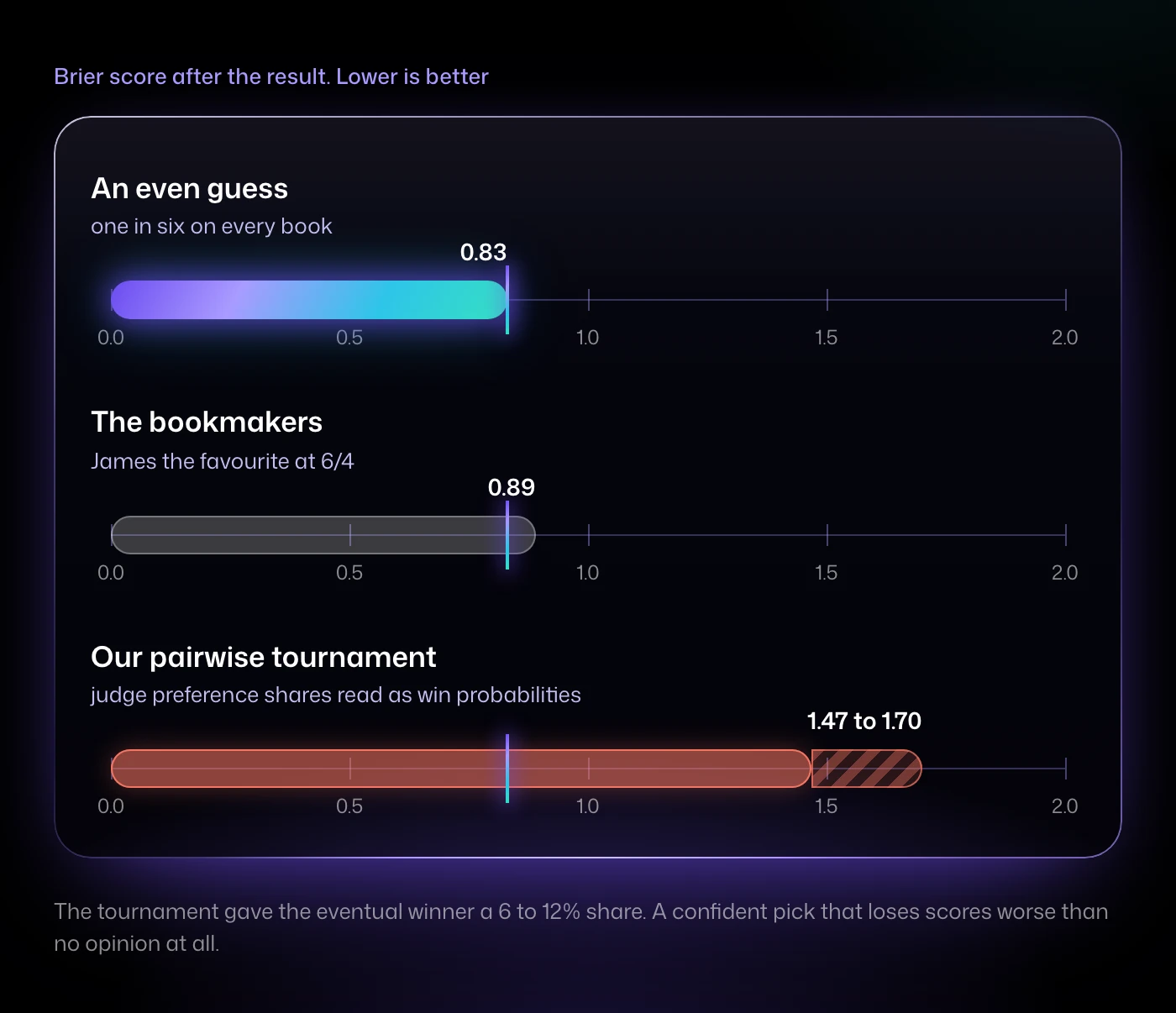
How can a method that passes every quality check do worse than an even guess? Preference shares measure how often the judges pick a book. They don't measure the chance that a panel of five people picks it. Our judges agreed with each other, so the tournament put most of the weight on one book: 64 to 95%, depending on the setting. When that book lost, the Brier score punished the confidence. Our protocol warned that the shares weren't win probabilities, and the result showed why.
The lesson for any AI review: agreement between AI judges tells you the judges are consistent. It doesn't tell you they're right.
The market made the same bet
We weren't alone. The bookmakers' favourite was also James, at 6/4. Harrison was 4/1 (William Hill odds, as listed by OLBG in mid-October). The Reader's Room, a readers' panel blog, scored the six books before the shortlist came out and put Harrison's novel last.
Our jury rated Harrison higher than both. That doesn't rescue the forecast. It does show where the jury's reading differed from the crowd's, and that's worth tracking.
What we would do differently
Our own retrospective lists the mistakes. Four of them matter for anyone running AI judges:
- Test memory first. The recognition check took 48 calls and about 10 minutes. We ran it after we'd built cards for three past years.
- Fix every scoring parameter before you see results. We halved the Skeptic's penalty after the first runs. It didn't change the pick, but it moved places 2 to 6, and we had to seal the original ranking next to it.
- Keep a tuning set apart from the test. We tuned the prompts on the same six 2026 books we were predicting. Nobody knew the result yet, but we'd seen the order.
- Check what each judge can reach. In early runs the GPT judges had web access through a user setting. We threw those runs out and reran everything in isolation.
What this means for any AI selection
The Booker is a small, public version of a problem many teams have: an AI ranks a pile of candidates, and someone must decide. Pitch decks, grant applications, tenders, accelerator intakes.
What the experiment says about that problem:
- Ask how a tool was tested. If it was scored on data the model may have seen, the result may be memory.
- Treat agreement between AI judges as consistency, not accuracy. Read the spread and the evidence.
- Look past first place. Our top pick lost, and the winner was in our top two. A shortlist holds up better than a single answer.
- Keep the decision with people. The Booker panel judged the books themselves. Our jury read summaries.
This is how EvalLens is built: AI prepares evidence-linked analysis, and your team makes the call. If you screen pitch decks or run a selection process, book a demo.
Common questions
Did the EvalLens AI jury predict the Booker Prize 2026 winner?
No. It sealed The Disappearers by Marlon James as its pick on 24 October 2026. On 9 November the Booker panel chose The End of Everything by M. John Harrison, which the AI jury had ranked second. The bookmakers' favourite was also James.
Why can't you test an AI jury on past Booker winners?
Both models recognised all 18 books from the 2023 to 2025 shortlists and knew the winners, even with author names removed. A test on past years would measure the models' memory, not their judgement. A forecast sealed before the result is the only clean test, and one result is a single data point.
Why did the pairwise tournament score worse than chance?
Its judges agreed with each other, so it gave most of the preference share to one book and only 6 to 12% to the eventual winner. Read as probabilities, those shares scored 1.47 to 1.70 on the Brier scale, worse than an even guess (0.83) and the bookmakers (0.89).
What does the Booker experiment mean for AI screening tools?
Agreement between AI judges shows consistency, not accuracy, and a test on data the model has seen may only measure memory. The safer use of AI is to prepare evidence and a shortlist. People should make the final decision and answer for it.
How can I check the sealed Booker prediction myself?
Download the envelope file from the first article and run shasum -a 256 booker-2026-seal.json. The output must equal the hash we published on 5 November 2026. Then hash the verdict file and compare it with the value stored inside the envelope.
Continue reading
Booker Prize 2026: the winner was our AI jury's second pick
Our sealed AI pick for the Booker Prize 2026 was The Disappearers. The winner, The End of Everything, was second. Full ranking and hash check.
Yaroslav VolovyiWho evaluates the evaluators?
Meta-evaluation for AI judges: an LLM matched a poetry quality proxy far better than non-experts. The harder question is who checks the evaluator.
Yaroslav VolovyiThe bias hiding in a single AI judge
Swap two decks and the verdict flips. Researchers have catalogued twelve systematic biases in a single LLM judge, and a newer model does not fix them. What fixes them is a panel that actually disagrees.
Vladislav Starodubov



AI prepares.
People decide.
EvalLens builds AI review workflows around your rules. Ready-made Pitch Evaluation starts in the EvalLens app; accelerator programmes and custom workflows are configured with your team.